Tunarr: open it, first login, settings, fixes
· Updated 18 September 2026 · SparkBox team
Builds always-on TV channels out of the movies and shows you already own, with schedules and a channel guide. Point any IPTV player — or Jellyfin's Live TV — at it. Requested by the community (#36995) as a modern alternative to ErsatzTV. This is the short card for it — the two minutes after you press Enable, and the page to come back to when something is off.
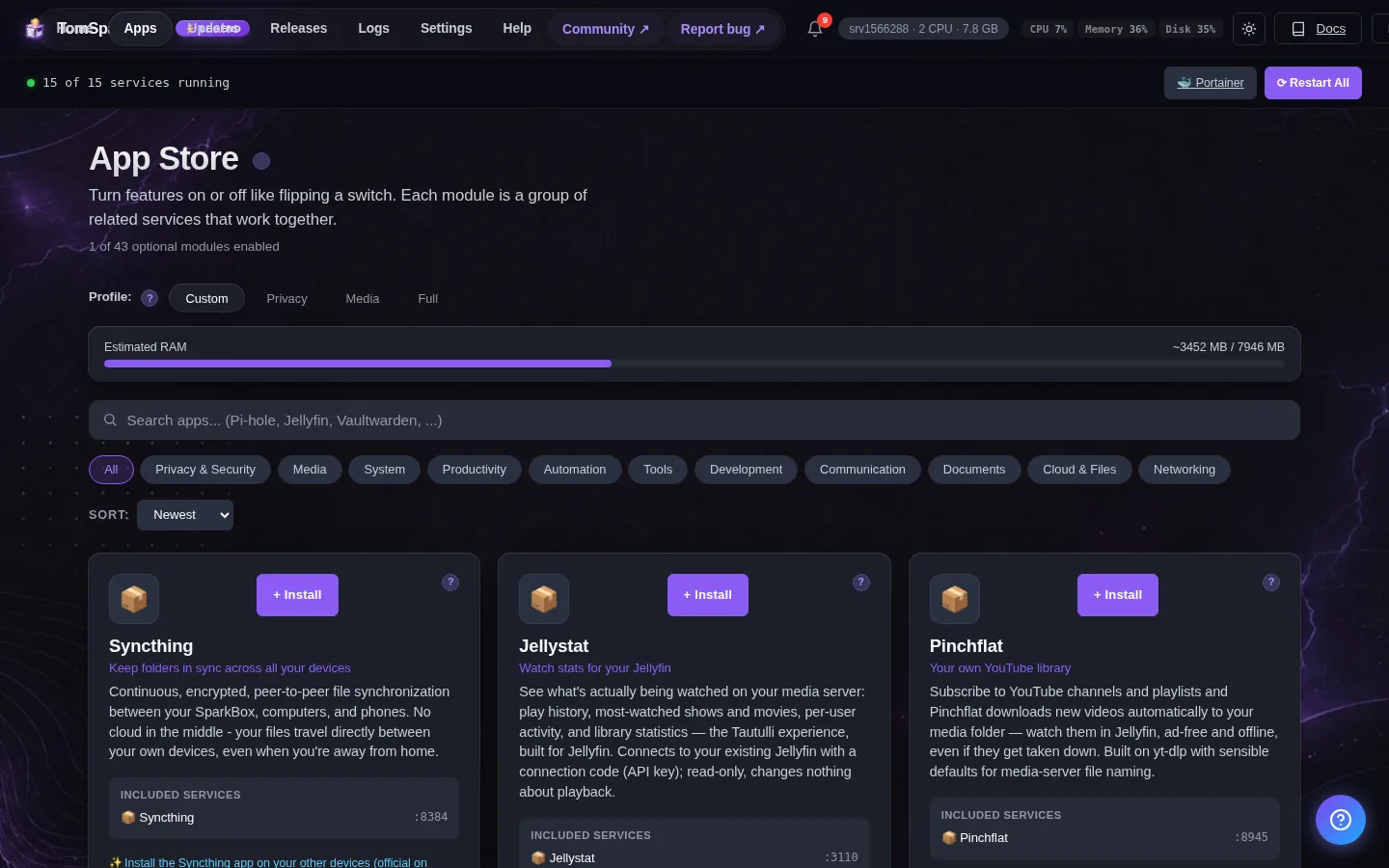
Open it
Dashboard → Apps → Tunarr → Open. The direct address on your network is:
http://<your-box-IP>:8000Your Jellyfin is already connected — build your first channel under Channels.
First login
No account needed — Tunarr opens straight into its own web interface. Anyone who can reach it on your network can change your channels, so keep it on your LAN rather than exposing it to the internet.
Any password the installer generated for you is under Settings → Passwords; the Open button offers to copy it.
Worth knowing
- Best on a box with hardware transcoding — a live channel encodes continuously, so without a GPU it leans on your CPU.
- SparkBox connects Tunarr to your Jellyfin for you and switches on your Movies and TV libraries — go straight to Channels and build one, then confirm it plays before adding more.
- Point any IPTV app at the playlist, or add Tunarr to Jellyfin under Live TV as an M3U tuner.
Build your first channel
Tunarr needs three things before anything plays, in this order:
- A media source — already done. When the Media Center runs on this box, SparkBox adds your Jellyfin under Media Sources as "Jellyfin (SparkBox)" and switches on its Movies and TV libraries (they scan in the background for a few minutes). A claimed Plex server is added the same way. Nothing there? The Media Center's first setup hasn't finished yet — it is added automatically once it has. You can still add a source by hand: Jellyfin is at
http://sb-jellyfin-media:8096. - A channel. Under Channels, create one. The default "offline" mode shows an offline screen until you add programming, so make a channel and give it a number.
- Programming. In the channel's Programming tab, add your library — start with one show or collection so you can tell it is working. Flex or cycle, either is fine to start.
Give it a minute after saving, then open the channel in Tunarr's player. It builds the upcoming block in advance, so a brand-new channel is briefly empty before it fills in.
Watch it on your TV
Tunarr hands out standard IPTV endpoints, so anything that speaks IPTV can play it:
Playlist: http://<your-NAS-IP>:8000/playlist/channels.m3uTo watch through Jellyfin, open Jellyfin's dashboard and go to Live TV → Tuner Devices, add an M3U Tuner with the playlist address, then add the guide address under TV Guide Data Providers. Your channels then appear in Jellyfin alongside everything else.
If your box gets hot
Like ErsatzTV, Tunarr runs a continuous broadcast, so it can be re-encoding video as long as a channel is live. With the box's GPU switched on (the same JELLYFIN_HW_ACCEL setting Jellyfin uses), SparkBox passes the GPU to Tunarr too, tests it with Tunarr's own ffmpeg, and sets Tunarr's default transcode profile to use it (VAAPI on Intel/AMD, CUDA on NVIDIA). If you change that profile yourself, SparkBox leaves it alone. Without a GPU, expect steady CPU load, and keep to one or two channels.
If the box is struggling, the fastest fix is fewer live channels rather than a bigger memory limit — the cost is in the encoding, not the RAM.
When it breaks
If it will not open, check the app card first — a red dot means it is restarting or unhealthy, and this walkthrough reads the reason from its log. Tom AI on the dashboard can do the same for you.
Where your data lives
/opt/sparkbox/modules/tunarr/config/Included in the dashboard's Backup by default. Restoring that backup on a fresh install brings Tunarr back exactly as it was.
Questions, or did this not match your box?
Every guide here came from a real problem someone hit. If yours behaves differently, say so — that is how these get corrected, and how the fix gets prioritised.
We answer there rather than in a comment box, because that is where the people who have already solved it are.